
Selling a lot is not the same as earning a lot. At a quarry, the customer who takes the most tonnes may not be the one who brings in the most profit, and a fast-moving product may barely cover its cost. To find out, you need to look at the margin per product and per customer, not just turnover. This article explains how to calculate it with the data you already have and what decisions you can make from the result.
Margin per product: real price minus cost
The first step is to know how much each tonne of each product costs you (we explain this in the article on the price at the quarry gate) and compare it with what you actually charge. Look at the real average price, not the list price: it comes from dividing the amount invoiced for each product by the tonnes sold of that product, and it already includes discounts, special prices and credit notes.
For example, with made-up figures to illustrate the method:
| Product | List price | Real average price | Cost per tonne | Margin per tonne |
|---|---|---|---|---|
| Product A | 100 | 92 | 70 | 22 |
| Product B | 100 | 78 | 70 | 8 |
| Product C | 120 | 115 | 95 | 20 |
All three may look profitable on the price list, but product B loses almost all of its margin to discounts. With the table in front of you, the question stops being "how much B do we sell" and becomes "who are we selling it to so cheaply, and why".
Margin per customer: what doesn't show up on the invoice
Two customers who buy the same product at the same price can leave you very different margins. What makes the difference:
- Discounts and special prices agreed, sometimes years ago.
- Haulage: whether the haulage charge you bill covers what it costs you to deliver the material to their sites.
- Payment term: being paid at 90 days carries a financial cost that being paid in cash does not.
- Non-payment and late payment: the risk of not getting paid, and the time spent chasing.
- Order size: lots of small loads eat up loader, weighbridge and office time.
- Administrative cost: customers who require invoices per site, extra documentation or frequent corrections.
You don't need to calculate everything down to the last cent. It is enough to estimate the costs that weigh most in your case and apply them consistently to all customers.
How to do the analysis step by step
- Choose the period. A full year prevents the seasonality of construction work from distorting the result.
- Pull the sales by customer and product: tonnes, amount invoiced and haulage.
- Apply the cost per tonne of each product and the haulage cost.
- Add the costs per customer: financial cost of the payment term, non-payment, small loads.
- Rank customers by total margin, not by turnover, and also look at the margin per tonne.
- Check the result with people who know the customers: the salesperson or the weighbridge operator will be able to explain many of the odd figures, such as a site that paid late because of a one-off problem or a special price agreed for a volume that never materialised.
- Repeat the analysis every year using the same method to see the trend.
How to read the result
When you cross volume with margin per tonne, customers tend to fall into four groups:
| Group | Situation | What to do |
|---|---|---|
| High volume, good margin | Your best customers | Look after them: service, availability, stable terms. |
| Low volume, good margin | Profitable customers who could buy more from you | Offer them other products or more service. |
| High volume, low margin | They keep the plant busy, but you earn little from them | Review discounts, haulage and payment terms. |
| Low volume, low margin | They use up resources without contributing | Adjust prices or terms, or move them to cash payment. |
Products work in a similar way. Some give no margin but are unavoidable, because they come out of the same blast as the profitable ones. In those cases, the decision is not to stop producing them, but to find an outlet for them so they don't pile up in the stockpile.
Nor is it wise to decide on numbers alone. A low-margin customer may be the one who keeps your plant busy in the slow months, and a low-margin product may be the one that makes a builder buy everything else from you. The analysis is there to help you negotiate knowing what is at stake, not to cut relationships automatically.
Common mistakes
- Measuring only turnover and rewarding the customer who buys the most, even if they leave little profit.
- Using the list price instead of the real average price.
- Forgetting haulage, or treating it as just more income without deducting its cost.
- Not taking the payment term and non-payment into account.
- Keeping special prices with no review date.
- Doing the analysis once and not repeating it.
What to do with the results
- Review special prices one by one and give them an expiry date.
- Introduce minimums per trip or surcharges for small loads.
- Adjust payment terms: early-payment discounts or guarantees for customers who pay late.
- Separate material and haulage in quotes so you know which part the customer is negotiating.
- Communicate changes in good time and with reasons: customers accept an increase better when it is explained.
The analysis with Arigest
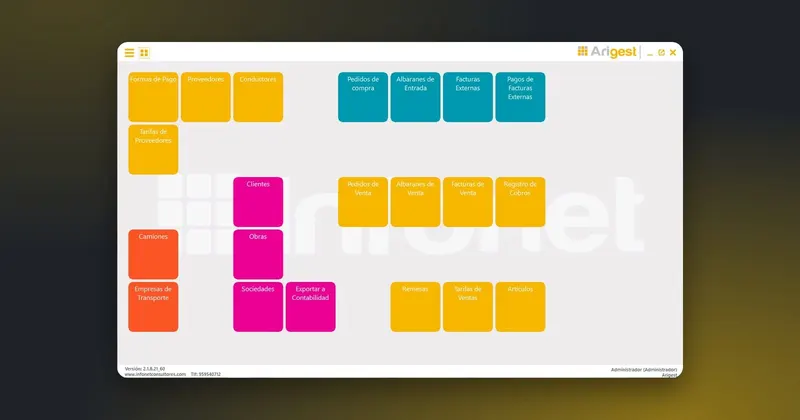
For all this you need clean data: each sale linked to its customer, site, product, price and actual weight. Arigest generates delivery notes with the weight read from the weighbridge and records all that data in them, so the starting point is reliable. You can see it in delivery notes and invoicing.
From there, Arigest offers comparative charts of sales, costs and invoicing by different criteria, and customised listings of any form. It also manages payment methods, payment records and bank movements linked to invoicing, which help you assess each customer's payment term, and in quarry management you record vehicles, consumption, transport and haulage. You can see the whole program on the Arigest page.