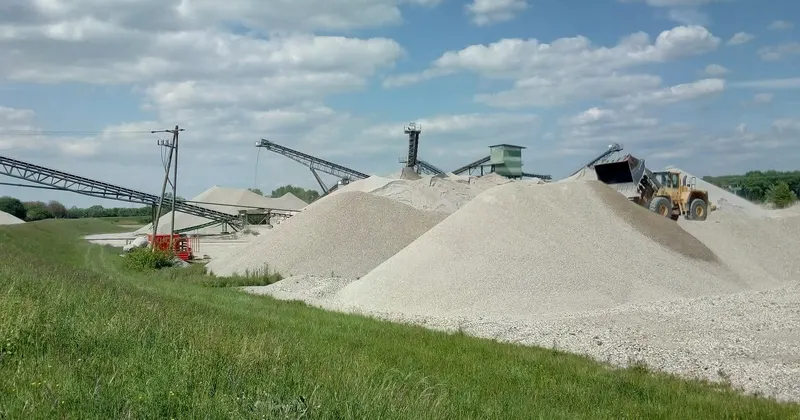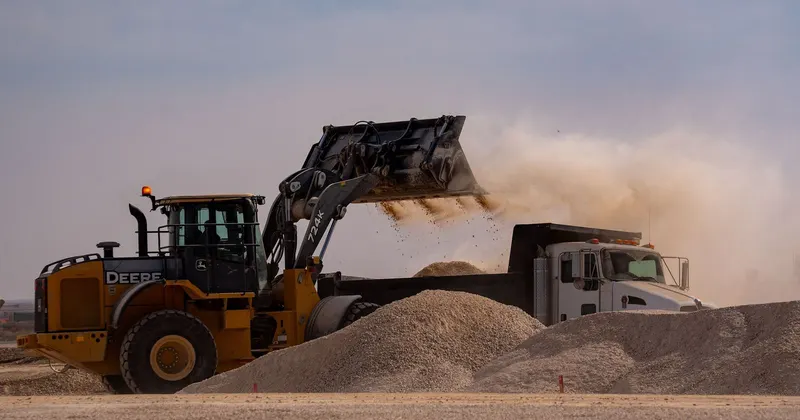
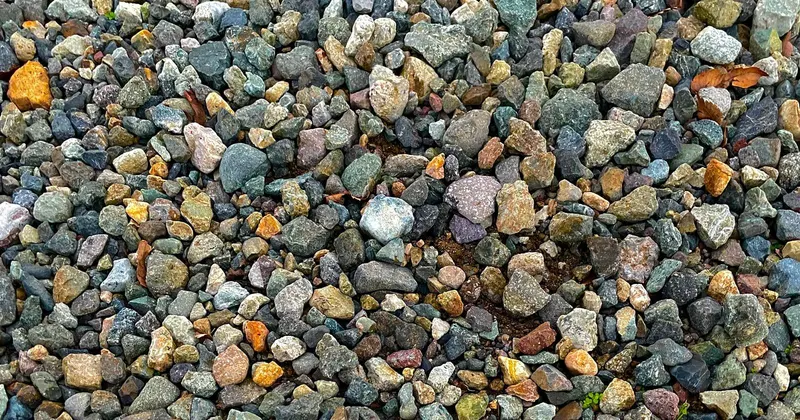
A customer phones in and asks for "gravel", and the quarry has six products that could fit. Knowing the different types of aggregates, how they are named and what each one is used for helps you sell the right product, avoid returns and organise your catalogue so that delivery notes and invoices speak the same language. This article reviews the most useful classifications and the most common uses of each material.
By origin: natural, manufactured and recycled
- Natural rounded aggregates: they come from gravel pits and river or terrace deposits. They have rounded shapes and often only need grading and washing.
- Natural crushed aggregates: they are obtained by crushing quarry rock (limestone, granite, basalt, quartzite…). They have fractured faces and sharp edges, which improves friction between particles.
- Manufactured aggregates: they come from industrial processes, such as some slags.
- Recycled aggregates: they are obtained from treated construction and demolition waste.
The parent rock has a major influence on properties: a hard limestone and a soft sandstone are not suited to the same uses, even if they are crushed to the same size.
Particle shape matters too. Rounded aggregate gives more workable mixes and needs less water in concrete, whereas crushed aggregate, with its fractured faces, interlocks better in road layers and bituminous mixes. That is why some projects explicitly ask for a minimum percentage of fractured faces and others prefer rounded material. If your quarry only produces one of the two types, it is worth being able to explain to the customer which uses it suits best and which it does not.
By size: the d/D designation
Aggregates are designated with two numbers, d/D, which indicate the minimum and maximum particle size in millimetres. A 0/4 sand ranges from 0 to 4 mm; a 4/12 fine gravel, from 4 to 12 mm. Always using this designation in the product name avoids a lot of confusion. In general terms:
| Product | Description | Common uses |
|---|---|---|
| Filler | Mineral powder, the finest fraction | Bituminous mixes, mortars, industrial applications |
| Sand | Fine fraction, up to a few millimetres | Concrete, mortars, trench backfill, pipe bedding |
| Fine gravel and gravel | Coarse fractions, in different cuts | Concrete, bituminous mixes, drainage, landscaping |
| Zahorra (crushed granular base material) | Mix of coarse and fine particles with a continuous grading curve | Road bases and sub-bases, formations, tracks |
| All-in (run-of-quarry) | Ungraded material, as it comes from the face or the primary crushing stage | Fills and embankments, haul roads |
| Ballast | Coarse, highly resistant crushed stone | Railway tracks |
| Rock armour | Large blocks of rock | Breakwaters, bank and slope protection, walls |
By use: the families of standards
The harmonised European standards for aggregates are organised according to end use, and it is useful to know them because each one demands different properties. According to the list given in an instruction from Spain's Ministry of Industry on aggregate control, they are as follows:
- UNE-EN 12620: aggregates for concrete.
- UNE-EN 13043: aggregates for bituminous mixes and surface treatments for roads, airfields and other trafficked areas.
- UNE-EN 13055: lightweight aggregates.
- UNE-EN 13139: aggregates for mortar.
- UNE-EN 13242: aggregates for hydraulically bound and unbound materials for use in civil engineering work and road construction.
- UNE-EN 13383: rock armour.
- UNE-EN 13450: aggregates for railway ballast.
The same product can be sold for several uses if it meets what each standard requires. Always check the current edition of each one with your notified body or in the UNE catalogue.
The properties that are checked most often
When a technical customer asks about an aggregate, they usually want to know one of the following:
- Grading: how the sizes are distributed within the product. It is the most closely controlled property.
- Shape: the flakiness index or the shape index. Flat or elongated particles make concrete and road layers worse.
- Cleanliness: the fines content and its nature (sand equivalent, methylene blue). Clays cause problems in concrete and in mixes.
- Resistance to fragmentation: the Los Angeles test. Important for road surfacing and ballast.
- Density and water absorption: they affect mix proportioning and behaviour in frost.
- Chemical composition: sulphates, chlorides, sulphur compounds or reactivity with cement alkalis, especially in aggregates for concrete.
How to choose the right aggregate
- Ask about the use, not just the size. A gravel for drainage and a gravel for structural concrete can have the same d/D and very different requirements.
- Ask for the specification of the project when it is public works or concrete.
- Provide the data sheet and the declaration of performance of the product when the use requires it.
- State whether the material is washed or not: it changes the cleanliness and, often, the price.
- Record the exact product on the delivery note, with its designation, so that there are no doubts later.
Common mistakes with product names
- Calling the same product different things depending on who dispatches it.
- Using trade names without the size, which the customer cannot compare.
- Changing the cut of a product (for example, from 4/12 to 6/12) without changing its name in the system.
- Mixing washed and unwashed material under the same item.
Your product catalogue in Arigest
A well-organised catalogue is the basis for selling, invoicing and analysing. In Arigest each product is an item with its own price list, and each sales delivery note records the item and the price together with the weight read from the weighbridge, the customer and the project. This way, whatever leaves the plant is recorded under the exact name of the product and carries through unchanged to invoicing.
With items properly defined, custom reports and comparative charts of sales, costs and invoicing by different criteria let you see which products move the most and which the least. You can see how it all fits together in quarry management or start from the Arigest home page.