If you sell aggregates for construction, CE marking is not optional: it is what allows you to place them on the market for the uses covered by harmonised standards. In addition, since 2026 there has been a new European regulation that has raised questions in the sector. This article explains which standard requires it, which documents a quarry needs to have, what production control involves and what has changed (and what has not) with the new regulation.
Which standard requires it and what changed in 2026
The basis is Regulation (EU) 305/2011 on construction products. When a product is covered by a harmonised standard, the manufacturer must issue a declaration of performance (Article 4) and affix the CE marking (Articles 8 and 9).
In December 2024, Regulation (EU) 2024/3110 was published. It replaces the previous one and applies, for the most part, from 8 January 2026. However, the transition is a long one:
- Its Article 94 repeals 305/2011 from 8 January 2026, except for a group of articles (including those governing the declaration of performance and CE marking), which are not repealed until 8 January 2040.
- Its Article 95.3 provides that harmonised standards published under the previous regulation and in force on 8 January 2026 remain valid until the Commission withdraws them.
- Its Article 95.8 states that those articles of 305/2011 continue to apply to products covered by those standards.
- Its Article 95.9 provides that the new obligations apply to each product family one year after the act making its new harmonised standard mandatory is adopted, unless that act sets a later date.
In practice, for aggregates you continue to work with the current harmonised standards and with the rules of 305/2011 until the new specifications for this family are published. We have not been able to confirm from official sources when this will happen: keep an eye on the Commission's publications and consult your notified body.
Which aggregates need CE marking
Aggregates intended for construction that are covered by one of the harmonised aggregates standards: for concrete (UNE-EN 12620), for bituminous mixtures (UNE-EN 13043), lightweight aggregates (UNE-EN 13055), for mortar (UNE-EN 13139), for unbound and hydraulically bound materials in civil engineering and road construction (UNE-EN 13242), armourstone (UNE-EN 13383) and railway ballast (UNE-EN 13450). The marking relates to the intended use: the same product may have declared performance for several uses, each under its own standard.
If the aggregate is for structural concrete, you should also bear in mind the Structural Code (Real Decreto 470/2021, the Spanish royal decree approving the Structural Code), which sets its own requirements for materials used in structures.
The documents you need
- Declaration of performance. It states the product's performance in relation to its essential characteristics, in accordance with the applicable harmonised standard, and follows the model in Annex III of Regulation 305/2011. By issuing it, you take responsibility for the product meeting that performance.
- Copy for the customer. Article 7 requires you to provide a copy of the declaration, on paper or in electronic form; if the customer asks for it on paper, you must supply it. It can also be published on a website under the conditions set by the Commission.
- Technical documentation. The tests, the production control and the rest of the documentation that supports the declaration. Article 11.2 requires you to keep it, together with the declaration, for 10 years from the placing of the product on the market.
- Notified body certificate, where the assessment system requires it.
Factory production control
The heart of CE marking for aggregates is factory production control (FPC): a documented system that ensures that what leaves the plant has the declared performance. The assessment system that applies to each use is set out in Annex ZA of the harmonised standard. Under system 2+, the one most often cited for aggregates, a notified body carries out the initial inspection of the plant and the FPC, along with continuous surveillance; check in the standard which system applies to your product and its use.
An FPC usually includes:
- A description of the production processes and the points at which they are controlled.
- A testing plan with frequencies: particle size distribution, shape, fines, strength, density and chemical properties, depending on the use.
- Calibration of testing and production equipment.
- Handling of non-conforming products: what is done with a batch that does not comply.
- Records of all of the above, which the notified body will review.
The minimum testing frequencies are set by the harmonised standard itself. If the aggregate is also subject to other regulations (public works specifications, the Structural Code), you may be asked for more.
What information accompanies the CE marking
Article 9.2 of Regulation 305/2011 states that the CE symbol must be followed by the last two digits of the year in which it was first affixed, the name and address of the manufacturer (or its identifying mark), the product-type code, the reference number of the declaration of performance, the level or class of the declared performance, the reference to the standard applied, the number of the notified body where applicable and the intended use.
With bulk material there is no product to attach it to. Article 9.1 allows the marking, in such cases, to be placed on the packaging or on the accompanying documents, so it is common for it to accompany the delivery note.
Common mistakes
- Declaring performance that has not been tested at the frequency the standard requires.
- Using an old declaration after changing the particle size distribution or the working face.
- Delivering material without the marking information or without the reference to the declaration of performance.
- Product names on delivery notes that do not match those on the declarations.
- Thinking the new regulation already requires you to redo everything, or, conversely, ignoring it.
Where Arigest fits in
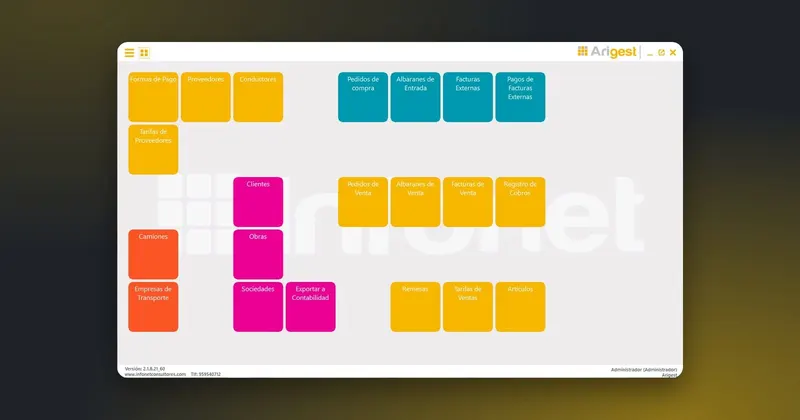
CE marking is the responsibility of the manufacturer and its notified body, and Arigest does not replace it. What it does give you is an orderly record of every delivery: the Arigest sales delivery note captures the plant, the series, the customer, the site, the lorry, the driver, the weights read from the weighbridge and the item. If one day you need to know which product went to which site and when, you will find it in the delivery notes and in the custom reports.
You can see how delivery notes and invoices are generated in delivery notes and invoicing, and how the rest is organised in quarry management. The most common questions are answered in the frequently asked questions.