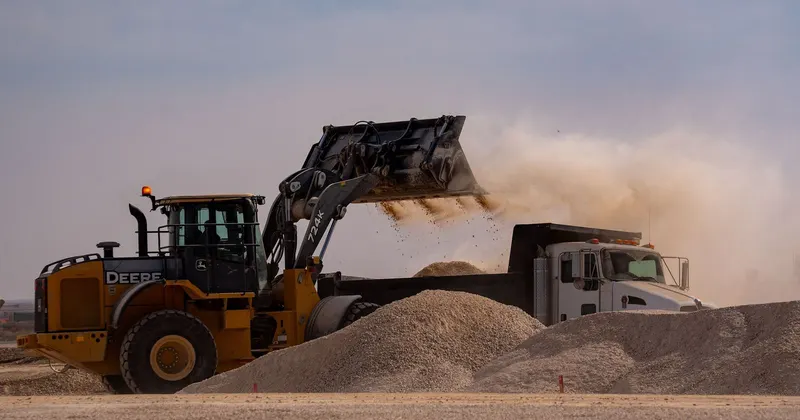
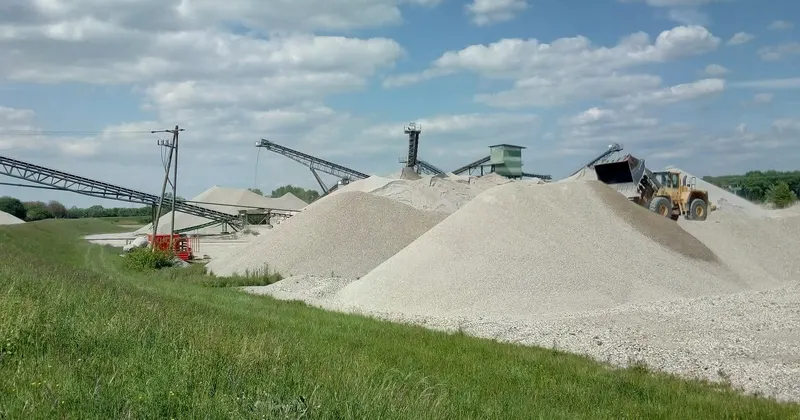
In a quarry, stock isn't sitting on a shelf: it's piles of material out in the open that change shape every day. Knowing how many tonnes are in each stockpile matters when you commit to deliveries, plan production and close the year's accounts with an inventory you can stand behind. This article explains how to keep control by combining an input and output balance with physical measurement of the stockpiles.
Why aggregate stock goes out of balance
The stock in an aggregates plant moves through many channels at once. Material comes in from the processing plant, sometimes from purchases from other quarries, and goes out over the weighbridge to customers. But there are also movements that nobody records: material the loader uses to repair tracks, rejects that go back to the crusher, losses from washing, rain that carries away fines, or stockpiles that mix at the edges. Each one is small, but added up over a year they can explain a large gap between what the paperwork says and what is on the ground.
The balance: what comes in minus what goes out
The basis of control is a simple calculation for each product and each period:
Closing stock = opening stock + production + purchases − sales − internal consumption − losses
Each term has its own reliability:
| Term | Where it comes from | Reliability |
|---|---|---|
| Sales | Delivery notes weighed on the weighbridge | High, if everything leaves via the weighbridge |
| Purchases | Supplier delivery notes, ideally reweighed on arrival | High if weighed; medium if you trust the supplier's paperwork |
| Production | Belt scales, plant hours, loader buckets counted | Medium or low, depending on the system |
| Internal consumption | Work reports for the machinery | Low if not recorded |
| Losses | Estimate | Low |
The conclusion is clear: outputs over the weighbridge are your most solid data. If you make sure that everything leaving the quarry goes over the weighbridge and is recorded under the correct item, the rest of the balance can be adjusted using physical measurements.
How to measure what is in the stockpile
To check the balance you need to measure the stockpile from time to time. There are several ways, from the simplest to the most precise:
- Geometric estimate: taking measurements of the stockpile and approximating it to a cone or a prism. It is quick, but only suitable for regularly shaped stockpiles.
- Topographic survey: with a total station or GPS, points on the surface are taken and the volume is calculated against a known base.
- Drone flight: photogrammetry generates a terrain model and calculates the volumes of all the stockpiles at once. It requires the base of the stockpile to be well defined.
Any of these methods gives you a volume in cubic metres. To convert it to tonnes you need the bulk density of the stockpiled material, which is not the density of the rock: it includes the gaps between particles and varies with grading and moisture. A wet sand and a dry coarse gravel have very different bulk densities.
The most reliable way to find it is to measure it with your own material: weigh a loaded lorry of known volume on the weighbridge, or run a laboratory test. Using a table value for every product is a frequent source of error.
How often to count and what to do about the difference
A physical measurement at year end is the minimum for the accounting inventory. If stock conditions your sales (for example, because you work with slow-moving products or large supply contracts), it is worth measuring more often, quarterly or monthly for critical products.
When the measurement and the balance don't match, don't just adjust the figure. Look at where the difference comes from:
- Check whether there are unassigned delivery notes, or ones with the wrong item, in that period.
- Check the bulk density you used and whether the material was wet.
- Check the base of the stockpile: if it has sunk or mixed with the ground, the volume comes out inflated.
- Ask at the plant about internal consumption or transfers between stockpiles that were not recorded.
If the difference always goes the same way and in the same product, there is probably a systematic loss that you can estimate and include in the balance as a percentage.
Good practice in the stockpile yard
- One stockpile per product, with enough separation or walls so they don't mix.
- Clear signage with the product name, matching the one on the delivery notes.
- A prepared and known base, so you don't lose material into the ground and can measure the volume.
- Loading from a tidy face, which makes measurements easier and reduces segregation.
- The same product names at the plant, on the weighbridge and in the office. If the loader loads "gravilla" and the delivery note says "grava 6/12", the balance will never add up.
Common mistakes
- Loads that leave without going over the weighbridge, for your own projects or trusted customers.
- Using the same bulk density for all materials.
- Measuring the stockpile just after rain or without knowing its base.
- Not recording purchases from other quarries as an input of the corresponding product.
- Changing product names halfway through the year.
What Arigest offers
The most reliable data in the balance is what comes from the weighbridge, and that is where Arigest works. The program is synchronised with the electronic weighing equipment to control incoming and outgoing tonnage, and it generates delivery notes with the weight it reads directly from the weighbridge. Each delivery note is linked to its item, its customer and its job, so the outputs of each product are recorded with the real weight. We explain it on the page about weighbridge connection.
Arigest manages purchase and sales delivery notes and invoices, with their items, and generates custom reports, so you can pull the inputs and outputs for the period by product and take them to your balance. If the weighbridge is far from the office, the four working modes let the weighings from the plant still reach the office. And from quarry management you also handle customers, suppliers, transport and consumption.