Every quarry has an expiry date, and the regulations require you to decide from day one how the land will be left once the material runs out. That is the restoration plan: a document that conditions the authorisation of the operation, requires you to provide guarantees and is reviewed periodically. This article explains what it is, what parts it has, how it is processed and why it is worth treating as one more cost of every tonne you sell.
Which regulation governs it
The restoration plan is governed by Real Decreto 975/2009, de 12 de junio, sobre gestión de los residuos de las industrias extractivas y de protección y rehabilitación del espacio afectado por actividades mineras (the Spanish Royal Decree on the management of extractive industry waste and the protection and rehabilitation of land affected by mining activities). It applies to the exploration and exploitation of the resources regulated by Ley 22/1973, de Minas (the Spanish Mining Act), which includes aggregates quarries and gravel pits. It has been amended several times; the latest update of the consolidated text, from October 2026, adds to the waste management plan a study on the possible recovery of critical raw materials. Always check the consolidated text in the BOE (Spain's Official State Gazette).
The competent authority is the mining authority of your autonomous community, which may have its own rules that develop or supplement the royal decree.
The basic obligations
Article 3 lays down several rules that shape everything else:
- The operator must take the necessary measures to prevent or reduce the negative effects of the activity on the environment and on human health.
- The abandonment, dumping or uncontrolled deposit of mining waste is prohibited.
- Rehabilitation must progress alongside the extraction. Only in justified cases is it permitted to leave it until the end of the quarry's life.
- The plan must be directed and signed by a competent professional with the qualifications required by law.
Progressive restoration has a practical advantage: you reduce the open surface area and, with it, the amount of the guarantee you have to maintain.
The five parts of the plan
| Part | Contents |
|---|---|
| I | Detailed description of the surroundings where the mining works will take place. |
| II | Measures to rehabilitate the natural area affected by exploration and extraction. |
| III | Measures to rehabilitate the ancillary services and facilities (plants, buildings, access roads). |
| IV | Mining waste management plan. |
| V | Implementation schedule and estimated cost of the rehabilitation works. |
Part II is the one most associated with restoration. According to article 13, it includes, where applicable, reshaping the terrain (with specific rules if the void is backfilled with the operator's own or third-party waste, or if it is left to flood), revegetation (objectives, soil preparation, topsoil, chosen species and their justification), rehabilitation of tracks and access roads, erosion control measures, landscape integration and the preliminary project for the final closure of the works.
The final land use is decided in the plan: natural area, agricultural, recreational, industrial or others permitted by law. It is a decision with economic consequences, because it conditions the works and their cost.
How it is processed and when it is reviewed
- Submission. The plan is submitted to the mining authority together with the application for the permit, authorisation or concession (article 4). You must demonstrate the economic, financial and technical capacity to carry it out.
- Public consultation. Article 6 provides for a public consultation period of no less than 30 days.
- Authorisation. The mining authority may approve it, request additions or introduce changes, after a report from the environmental authority (article 5). It is authorised at the same time as the mining title and is a special condition of it.
- Guarantees. Works may not begin until the financial guarantees have been provided (article 4.2).
- Review. The operator must review the plan every five years and amend it if there are substantial changes, including changes to the final land use; amendments are notified for authorisation (article 7).
- Closure. The authority does not accept the surrender of the title or authorise cessation until the plan has been carried out as far as is applicable (article 5.7).
Financial guarantees
Article 41 requires two financial guarantees or equivalent to be provided, which the authority calculates separately according to the criteria in annex IV of the royal decree:
- The guarantee for the operation and its processing facilities (article 42). It is provided before works begin and is calculated so that a qualified third party could carry out the rehabilitation if necessary. It is reviewed every year according to the work done and the surface area affected, in line with the work plan. It is released when the restoration plan is completed.
- The guarantee for mining waste facilities (article 43). It is provided before waste starts to be deposited. The article itself exempts certain inert waste and other cases, unless they go to a category A facility.
Guarantees may take the form of bank guarantees, insurance, funds held with financial institutions or other accepted arrangements, and the authority may call on them if the plan is not complied with. In addition, article 44 provides for inspections, at least once a year. The specific amounts depend on each operation and each autonomous community, so check with your mining authority how they are calculated in your case.
Common mistakes
- Leaving all the restoration until the end and accumulating open surface area and guarantee.
- Not reviewing the plan after five years or when the extraction project changes.
- Not keeping the topsoil from the stripping, which is later needed for revegetation.
- Not including the cost of restoration in the price of the aggregate.
- Backfilling the void with materials without recording their origin and nature, as article 13 requires.
How it relates to day-to-day management
The restoration plan is drafted by a competent professional and authorised by the administration: it is not something a management software does. But its cost is paid for with what you sell, and to spread it properly you need to know how many tonnes leave the quarry and of which products.
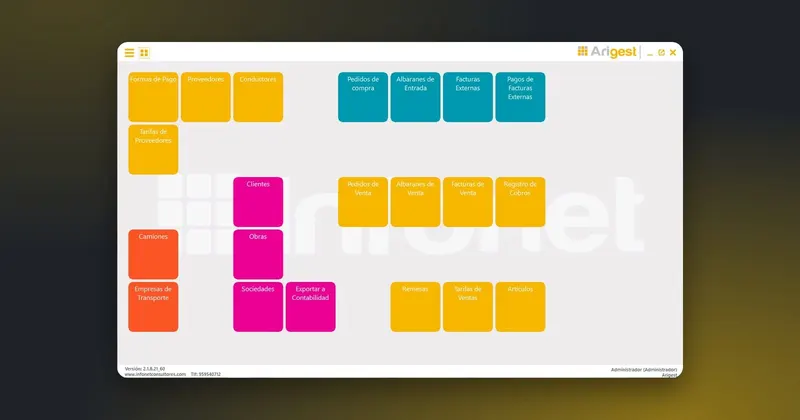
Arigest records every outbound load with the weight read from the weighbridge, the item, the customer and the site, and offers customised reports and comparative charts of sales, costs and invoicing by different criteria. With that data you can calculate how much each tonne should contribute to restoration and guarantees. From quarry management you also keep track of vehicles, consumption, spare parts and incidents, and in delivery notes and invoicing you can see how sales are recorded. Everything else is on the Arigest page.